
Sample Bequest Language for Your Nonprofit’s Website
Bottom Line Up Front (BLUF): Clear sample bequest language for charities on your website helps supporters and estate planning attorneys seamlessly include your organization in their wills or trusts.
By publishing accurate legal wording along with your federal tax ID number, legal name, and primary office address, your nonprofit removes friction, accelerates planned giving conversions, and secures long-term institutional funding.
Why Clear, Accessible Bequest Language Matters for Nonprofits
For many nonprofits, planned giving remains an underutilized revenue stream simply because potential donors find the legal process intimidating or confusing. When supporters decide to leave a legacy gift, they usually turn to your website to find the exact wording their attorney needs. If your planned giving web page lacks concise, accessible legal copy, those supporters may delay their estate planning decisions or omit your charity altogether.
Providing plug-and-play sample bequest language for charities bridges the gap between donor intent and legal execution. Professional advisors, such as estate attorneys and financial planners, work on tight schedules and appreciate nonprofits that make their jobs easier. By delivering standard legal clauses directly on your website, you ensure that your charitable estate planning language is copied accurately into wills and trust agreements without administrative back-and-forth.
Clear legal wording turns passive website visits into documented legacy commitments. When a donor sees that your organization provides ready-to-use legal text, it builds confidence in your stewardship capabilities. Modernizing your digital planned giving portal with accessible templates protects your nonprofit's future funding while offering an essential service to your most loyal supporters.
Essential Details Required for Legal Bequest Wording
Before drafting specific clauses, every nonprofit must identify its core legal credentials. Ambiguous organizational naming is a major cause of probate litigation and lost bequests. If a donor's will lists a generic name rather than your official legal entity name, courts may struggle to distribute the intended assets, leading to costly administrative delays or unintended allocations.
Every sample bequest clause on your website must prominently display three critical pieces of legal information: your official legal entity name, your primary administrative office address, and your nine-digit federal tax ID number (or EIN). These identifiers verify your tax-exempt 501(c)(3) status and ensure legal enforceability.
Formatting these corporate details in bold font makes them visually striking for site visitors. Estate planning attorneys often skim landing pages specifically searching for these three data points. Displaying them clearly at the top of your legal copy ensures that advisors capture the precise credentials required for formal estate documents.
Four Essential Types of Charitable Bequests to Know
Supporters structure their estate gifts based on their personal financial situations, family obligations, and overall wealth distribution goals. To accommodate varying preferences, your nonprofit bequest language should cover the four primary bequest categories: unrestricted bequests, specific dollar amount bequests, percentage-of-estate bequests, and contingent bequests.
Understanding how these bequest types differ allows your marketing and development teams to present them. Offering variety ensures every supporter, regardless of asset level, finds an option that aligns with their estate planning strategy.
Offering choices empowers donors to select a structure that best fits their family needs. Unrestricted options provide your leadership team with future operational flexibility, while percentage-based allocations protect the donor's estate value against economic fluctuations. Explaining these options in simple terms demystifies the planned giving process for non-attorneys.
Plug-and-Play Sample Bequest Language Templates for Nonprofits
Below are standard sample bequest language clauses that your charity can post directly on its planned giving web page. These templates offer clean legal phrasing for the four primary bequest types. Nonprofits should instruct site visitors to share these exact templates with their estate planning attorneys.
1. General Unrestricted Bequest Clause
An unrestricted bequest clause gives your organization maximum flexibility, allowing future leadership teams to allocate funds where community need is greatest.
"I give, devise, and bequeath to [Insert Official Corporate Name], located at [Insert Primary Office Address], Federal Tax ID Number [Insert EIN], the sum of $____ [or ____% of my estate; or describe specific property] to be used for its general tax-exempt operational purposes at the discretion of its Board of Directors."
2. Specific Dollar Amount or Asset Bequest Clause
A specific bequest designates a fixed sum of money or a specific piece of real estate, stock, or personal property.
"I give, devise, and bequeath to [Insert Official Corporate Name], located at [Insert Primary Office Address], Federal Tax ID Number [Insert EIN], the sum of $____ [or describe specific asset, such as real estate or securities] to be used for its general corporate purposes."
3. Percentage-of-Estate Bequest Clause
A percentage-of-estate bequest ensures the gift automatically fluctuates with the growth or contraction of the donor's total asset balance over time.
"I give, devise, and bequeath to [Insert Official Corporate Name], located at [Insert Primary Office Address], Federal Tax ID Number [Insert EIN], ____% of the rest, residue, and remainder of my estate, both real and personal, to be used for its exempt operating purposes."
4. Contingent Bequest Clause
A contingent bequest wording structure takes effect only if primary personal beneficiaries, such as a spouse or children, do not survive the estate owner.
"If [Name of Primary Beneficiary] does not survive me, I give, devise, and bequeath to [Insert Official Corporate Name], located at [Insert Primary Office Address], Federal Tax ID Number [Insert EIN], [insert dollar amount, percentage of estate, or residual percentage] to be used for its tax-exempt organizational purposes."
These standardized templates make drafting estate documents straightforward for donors and legal professionals alike. By hosting these clean text blocks on your donor portal, you eliminate guesswork and establish a clear path from initial consideration to formal legal commitment.
7 Organizations With Sample Bequest Language on Their Websites
When supporters decide to include your nonprofit in their estate plans, clear bequest language makes all the difference. Providing sample clauses on your website helps donors and their attorneys quickly draft gifts without costly delays or legal confusion.
Here are seven organizations that offer effective sample bequest language on their websites, along with what makes each example work so well.
Habitat for Humanity
What they did well: Visual cueing and distinct gift designations
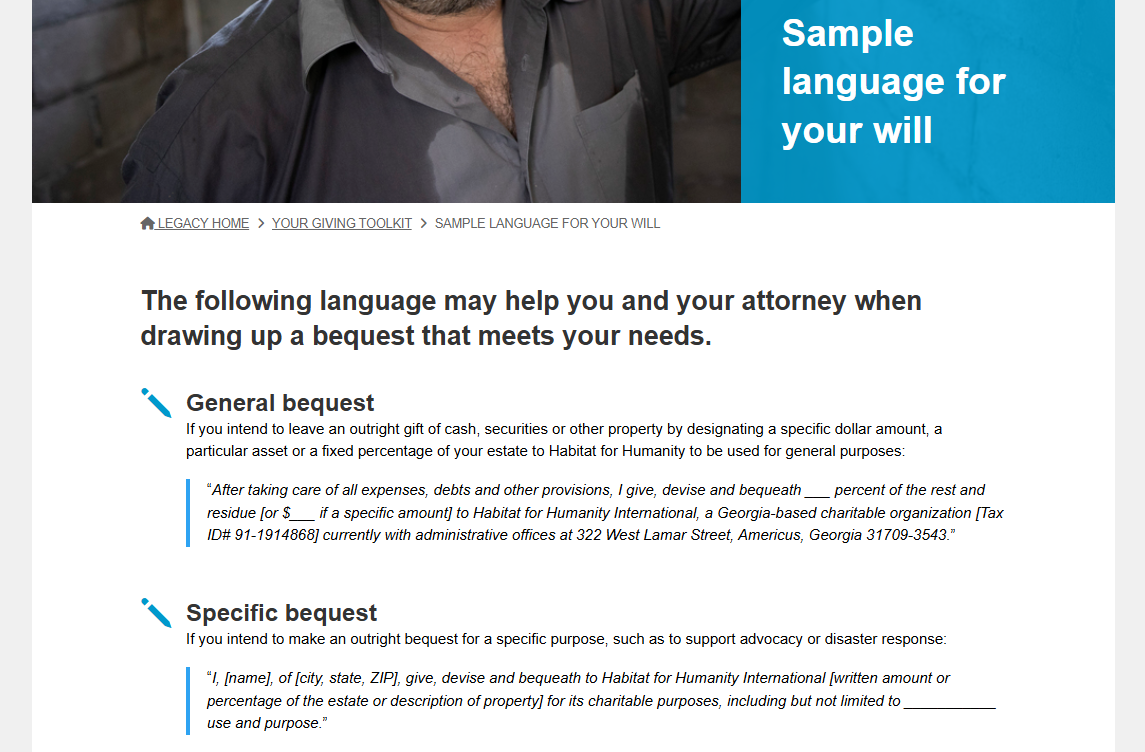
Habitat for Humanity uses clean pencil icons to separate general bequests from specific-purpose gifts, such as advocacy or disaster response
St. Jude Children's Research Hospital
What they did well: Clear, educational definitions and collapsible modules
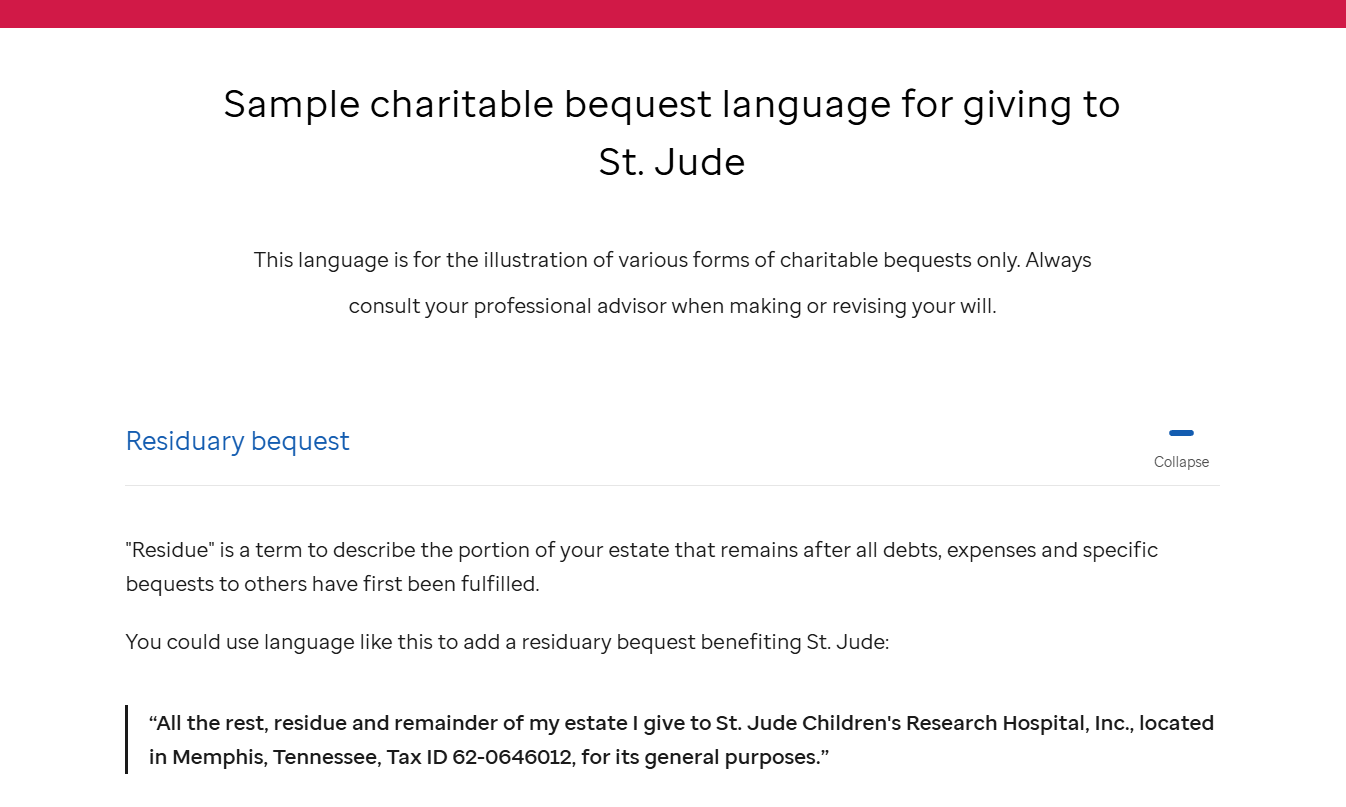
St. Jude explains what legal terms mean in plain English before showing the text. For example, they define residue as the portion of an estate left after all debts and specific gifts are fulfilled. Using collapsible sections also keeps the page neat and easy to skim on mobile devices.
Wounded Warrior Project
What they did well: Accessible formatting and essential identifiers up front
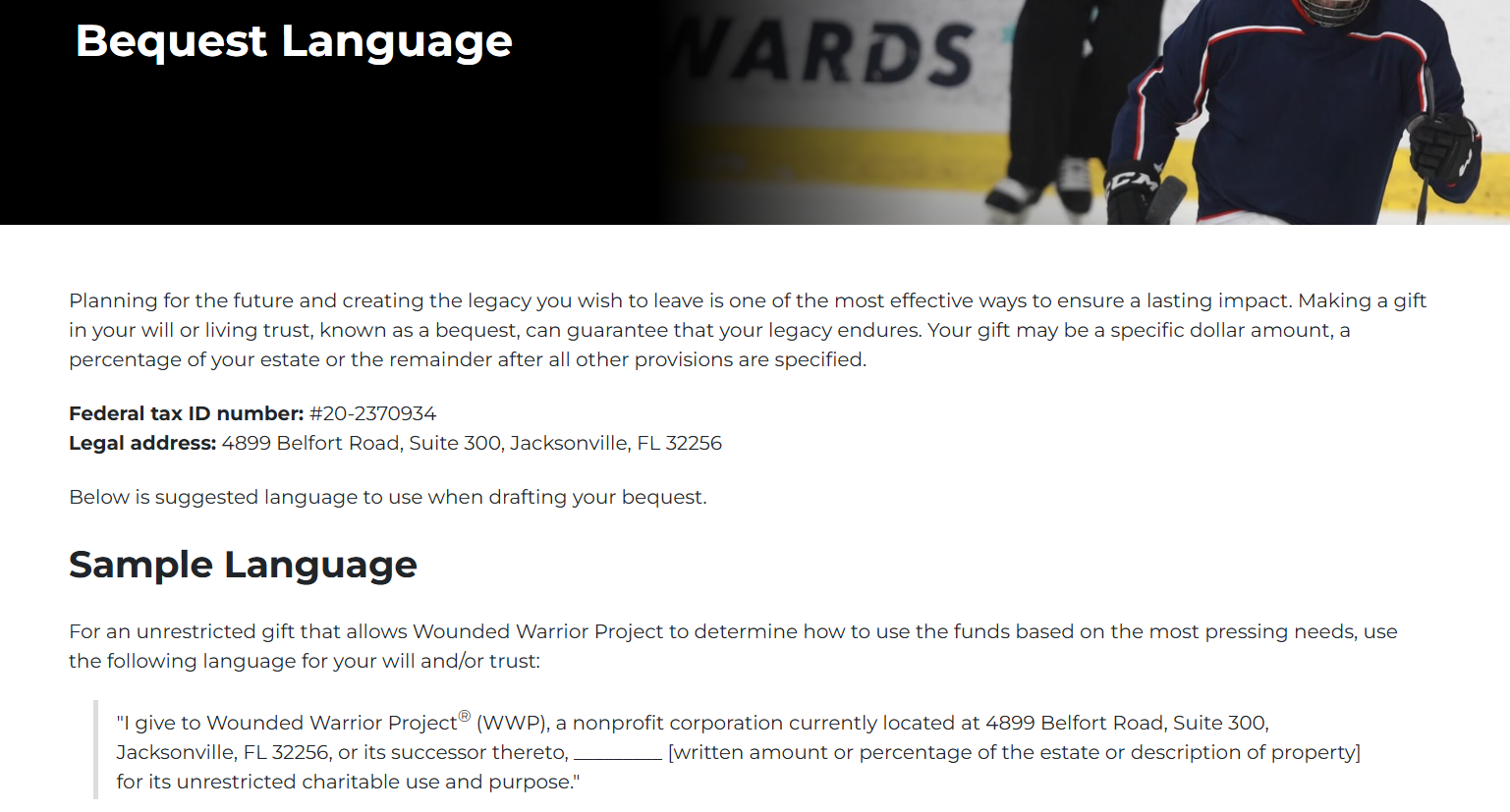
Wounded Warrior Project highlights its Federal Tax ID number and primary legal address at the very top of the section before introducing the sample language. This visual separation ensures that donors and advisors can quickly copy and paste critical filing data without digging through legal text.
AARP Foundation
What they did well: Actionable third-party estate planning integration
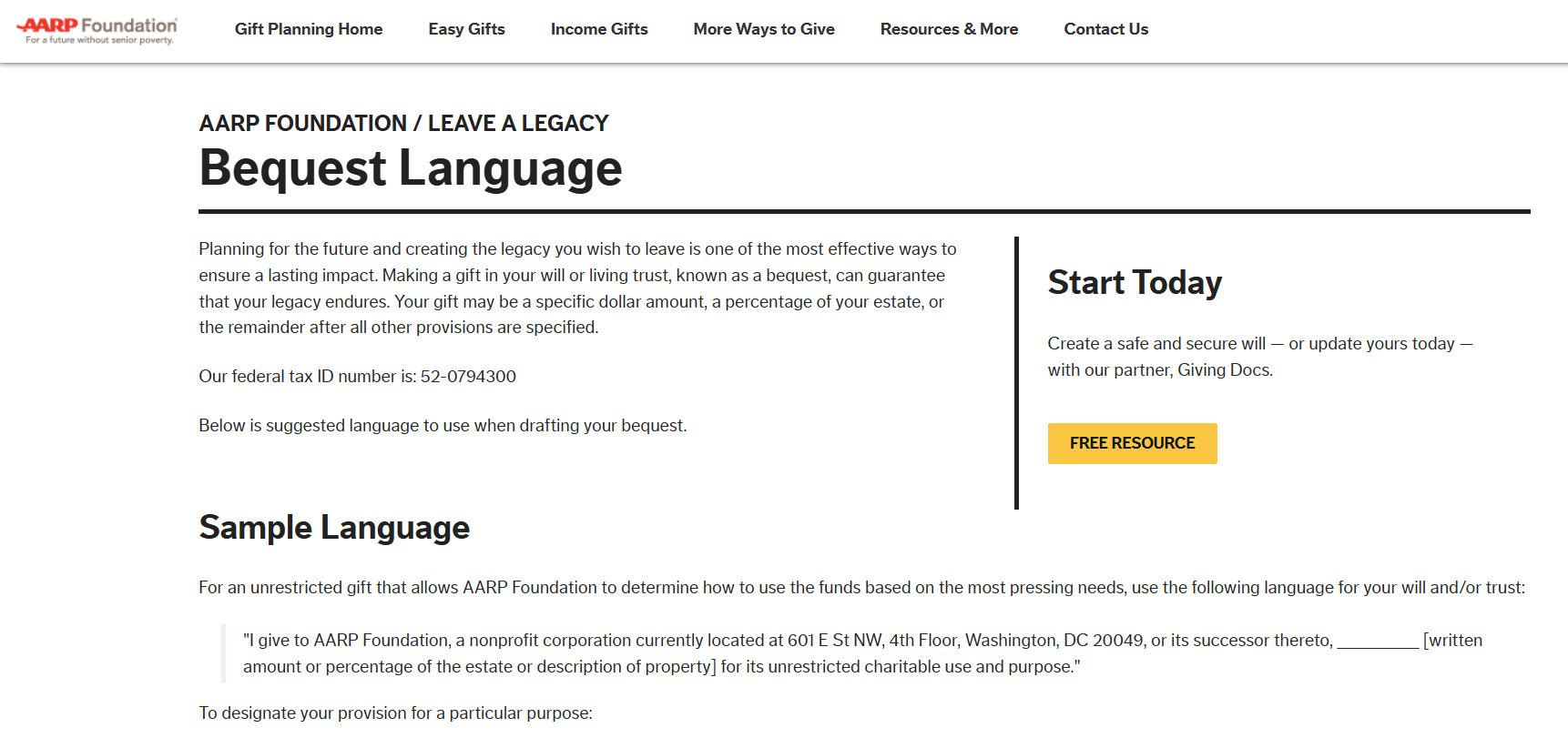
Alongside sample language that clearly specifies unrestricted support for urgent community needs, AARP Foundation includes a prominent Start Today callout. This directs supporters to a free online will-writing tool, removing both cost and hesitation for donors who do not have an attorney.
United Way Worldwide
What they did well: Clearly differentiated bequest categories
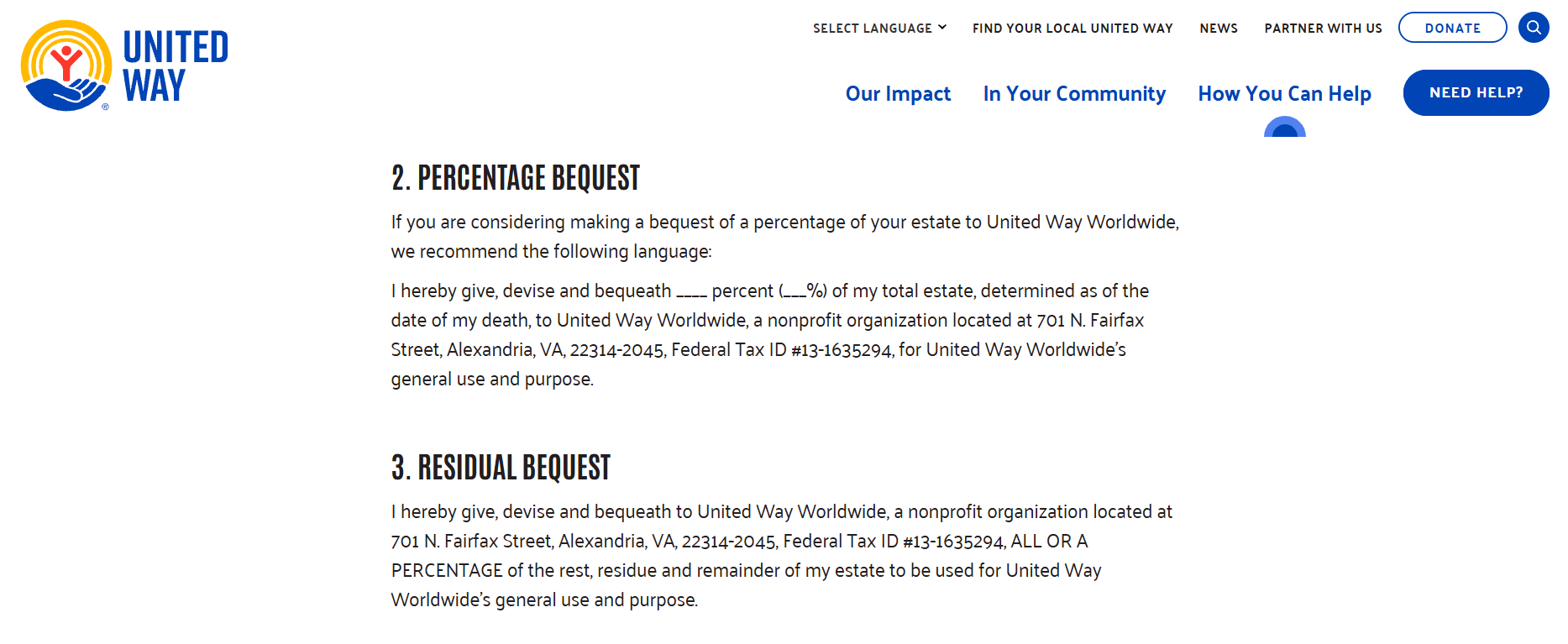
Rather than offering a single generic sentence, United Way Worldwide breaks down its sample language into numbered types, such as percentage bequests and residual bequests. This structure helps supporters match their exact giving goals to the right wording while keeping the charity's full address and Tax ID front and center.
Mayo Clinic
What they did well: Legal precision combined with stewardship
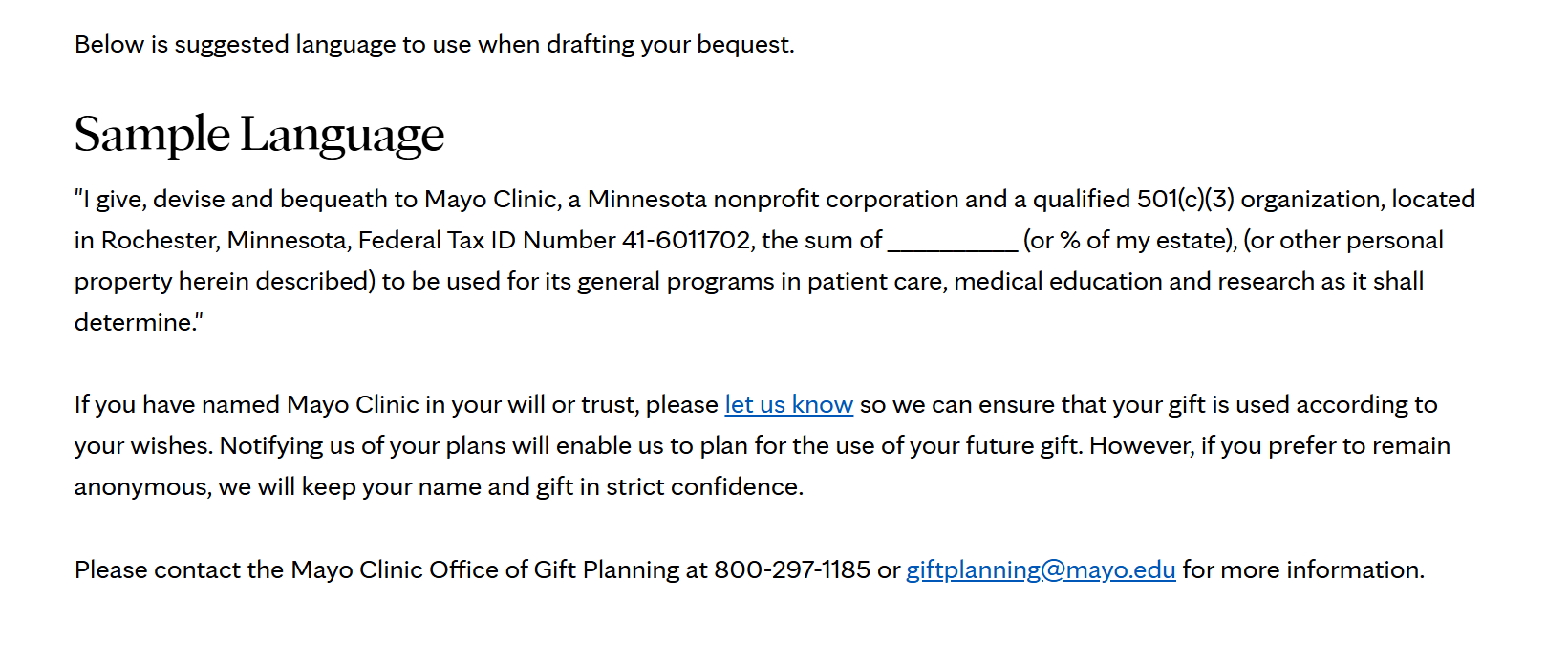
Mayo Clinic lists its exact legal corporate entity name, state of incorporation, headquarters location, and Federal Tax ID (EIN) right in the clause. Just below the snippet, they invite donors to reach out confidentially to confirm their wishes, building donor stewardship directly into the legal request.
Michael J. Fox Foundation
What they did well: Radical simplicity
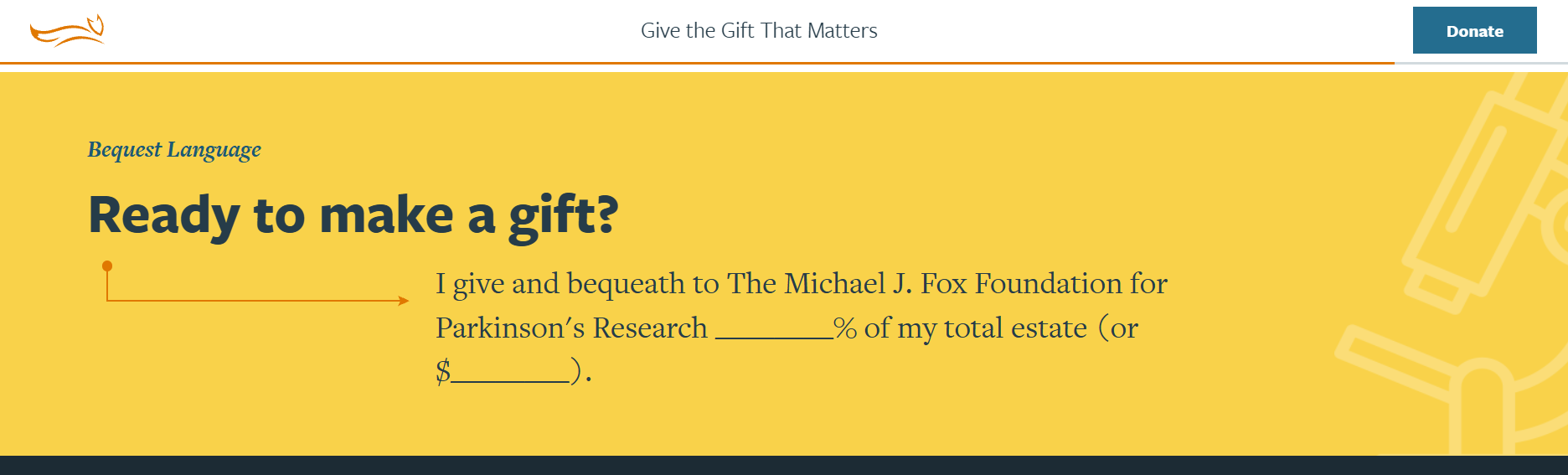
The Michael J. Fox Foundation strips away dense legal terms and presents a clean, single-sentence template: I give and bequeath to The Michael J. Fox Foundation for Parkinson’s Research % of my total estate (or $). It shows donors that leaving a legacy gift can be as simple as filling in a percentage or dollar amount, lowering the barrier to entry.
How Donors and Their Attorneys Use Online Bequest Language
Understanding how donors and professional advisors interact with your website helps you design a better digital user experience. When a supporter decides to include a charity in their estate plan, they rarely navigate your entire site. Instead, they land directly on your planned giving landing page or perform a search for your tax ID number EIN for planned giving.
The journey from initial interest to finalized bequest follows a predictable, multi-step progression. Modernizing your website to support each stage of this journey increases conversion rates and reduces administrative drop-off.
Estate planning attorneys frequently use copy-and-paste legal clauses to save time and prevent drafting mistakes. When your site provides clean, unformatted plain text alongside downloadable PDF options, attorneys can integrate your wording directly into their legal drafting software. Streamlining this workflow creates goodwill with advisors, who are then more likely to recommend your organization to other client donors.
Tips for Formatting Your Online Bequest Language
Publishing standard legal language is only effective if visitors can quickly find and copy it. Poor web design, hidden links, and cluttered layouts frustrate donors and cause advisors to look elsewhere. Formatting your planned giving web page for readability and accessibility ensures that site traffic translates into completed gifts.
To optimize your legal copy presentation, apply modern web design principles tailored specifically for planned giving audiences:
Use bold text for critical credentials: Ensure your organization's exact legal entity name, primary office address, and federal tax ID number (EIN) are clearly emphasized in bold font.
Provide one-click copy options: Include a "Copy Wording to Clipboard" button next to each sample clause so visitors can grab the legal text without formatting glitches.
Offer downloadable PDF reference sheets: Create a one-page, printable PDF that contains all sample clauses alongside your legal entity details for donors to take to their attorney visits.
Keep legal disclaimers clear and friendly: Remind visitors that your sample wording is for informational purposes and that they should consult a qualified estate attorney for formal advice.
Maintain high contrast and accessible font sizes: Ensure text is easy to read for older donors using mobile devices or desktop monitors.
These formatting choices create a modern, accessible web experience for all site visitors. When legal details are presented clearly, supporters feel confident managing their estate arrangements, knowing that your organization prioritizes transparency and attention to detail.
Summary & Actionable Next Steps
Providing accessible, plug-and-play sample bequest language for charities is one of the most effective ways to grow your nonprofit's long-term endowment. By clearly presenting your legal entity name, primary office address, and federal tax ID number alongside flexible bequest templates, your website becomes an active tool for lead generation and gift closure.
Ready to turn today's donors into tomorrow's legacy?
Make it easier, simpler, and accessible for your supporters to add your mission to their final plans.
Start for Free Book a demoGet the planned giving playbook
Monthly strategies, campaign templates, and stewardship ideas for fundraisers.
Recommended guides & articles
 For Nonprofits
Beneficiary Designations: Easy Estate Gifts Nonprofits Overlook
8 min read For Nonprofits
How Non-Binding Bequest Intention Forms Record Legacy Pledges
9 min read For Nonprofits
How to Write a Compelling Planned Giving Case for Support
8 min read For Nonprofits
How to Draft a Planned Gift Acceptance Policy (With Template)
6 min read