

Sustainable Legacies: Endowments vs. Unrestricted Bequests
Bottom Line Up Front: Evaluating endowment vs. unrestricted planned gifts is a critical decision for nonprofit leaders managing unexpected estate windfalls. By establishing clear board policies that balance permanent endowments, flexible quasi-endowments, and immediate operating reserves, executive directors and CFOs can protect donor intent, ensure long-term financial stability, and deploy capital effectively. When a substantial estate gift arrives without donor-imposed restrictions, nonprofit leadership faces both an extraordinary opportunity and a complex governance challenge. Executive directors, chief financial officers, and board chairs must decide whether to deploy the capital immediately to expand current programs, absorb it into general operations, or preserve the funds for future security. Without a pre-established policy, these decisions can trigger intense debate between board members who favor immediate deployment and those who advocate for long-term capital preservation. Navigating the strategic balance between endowment vs. unrestricted planned gifts requires leadership to weigh competing financial priorities. Allocating 100 percent of a large bequest directly into annual operating budgets can create an artificial revenue bulge, encouraging unsustainable expansion that becomes difficult to maintain. Conversely, locking every undesignated gift into a permanent endowment restricts liquidity, limiting the organization's ability to address pressing operational needs or invest in strategic growth opportunities. Establishing clear policies before a major windfall arrives removes emotion and personal bias from the allocation process. A proactive governance framework provides a structured pathway for distributing estate funds, ensuring that incoming gifts align with strategic priorities. This policy-driven approach protects organizational financial health while honoring the donor's legacy. To establish a sound allocation framework, leadership must first understand the legal and operational differences between true permanent endowments, board-restricted quasi-endowments, and unrestricted operating reserves. Confusion often arises because the term "endowment" is frequently used to describe both legally restricted funds and board-designated reserves, despite their different legal guidelines and administrative rules. A true permanent endowment is created when a donor explicitly states in their will, trust, or gift agreement that the principal amount must be held in perpetuity, with only the investment earnings or a fixed percentage distributed annually. In contrast, an unrestricted bequest carries no donor-imposed restrictions, granting the board full legal authority to allocate the funds where they are needed most. Understanding these distinctions helps leadership choose the right vehicle for undesignated estate gifts. While a donor-restricted endowment binds the organization under state UPMIFA statutes, a board-designated quasi-endowment delivers similar long-term investment benefits while preserving future capital flexibility. Distinguishing between donor intent and board policy allows executive teams to design financial strategies that support both immediate needs and long-term stability. Evaluating how to allocate undesignated estate gifts requires comparing the operational trade-offs of permanent endowments, quasi-endowments, and operating reserves. Each financial structure serves a distinct purpose within a nonprofit's overall capital model, balancing liquidity, investment growth, and long-term security. A balanced financial structure uses all three mechanisms strategically. Operating reserves provide immediate cash cushions for short-term revenue fluctuations, quasi-endowments offer flexible long-term capital for strategic initiatives, and permanent endowments deliver reliable, perpetual income to sustain core operations across generations. A common surprise for board members exploring permanent endowments is the modest size of the annual spending distribution relative to the total gift. To preserve purchasing power against inflation over time, modern endowment accounting practices mandate conservative annual payout rates, typically ranging between 4 percent and 5 percent of a multi-year moving average of the portfolio's market value. This conservative spending structure means that a substantial bequest produces a relatively small annual operating distribution. While this distribution continues indefinitely, leadership must evaluate whether immediate capital deployment might yield greater strategic value for the organization's mission today. Examining these financial mechanics highlights the trade-off between current deployment and perpetual support. A one-million-dollar undesignated bequest converted into a permanent endowment yields approximately $45,000 in annual operating support. That same million dollars deployed into an operating reserve could fund a multi-year regional expansion or resolve high-interest debt immediately. To prevent ad hoc financial decisions when an estate gift arrives, nonprofit finance committees should adopt an objective decision-tree framework. This operational flowchart guides executive teams and board members through a step-by-step review process, evaluating organizational risk, reserve health, and strategic priorities before allocating funds.The Executive Dilemma: Navigating Unplanned Legacy Windfalls
Defining the Core Allocation Structures
Permanent Endowments vs. Quasi-Endowments vs. Operating Reserves
Financial Mechanics and Payout Trade-offs
The Undesignated Bequest Decision-Tree Framework
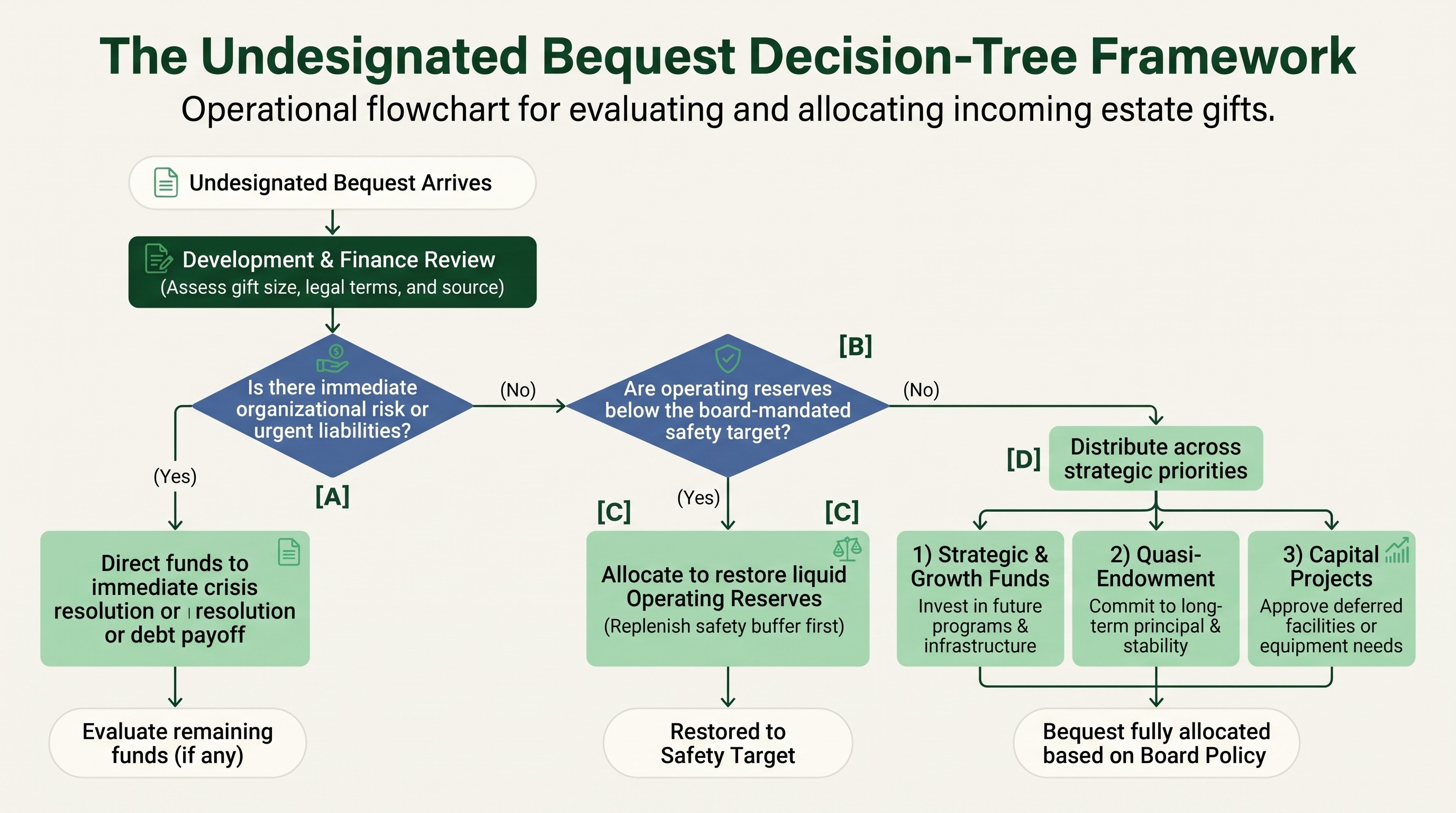
Visualizing this decision logic ensures that every undesignated bequest undergoes a consistent, objective evaluation aligned with board-approved financial policies. This framework ensures that basic financial health metrics are satisfied before funds are committed to long-term structures. If operating reserves fall below board-mandated safety targets, incoming undesignated bequests are used first to restore liquid financial buffers. Once stability is established, remaining funds flow smoothly into growth and quasi-endowment reserves according to pre-set policy rules.
Structuring a Tiered Unrestricted Bequest Allocation Policy
The most effective tool for managing estate windfalls is a formal, board-approved unrestricted bequest allocation policy. Rather than treating every bequest the same, a tiered policy sets clear financial thresholds based on gift size. Smaller estate gifts flow directly into current operations, while larger windfalls are systematically divided among operating reserves, strategic innovation funds, and board-restricted quasi-endowments.
A tiered framework reduces uncertainty, prevents debates during board meetings, and ensures large gifts support both short-term operational goals and long-term institutional financial resilience.
A tiered allocation policy lets organizations manage windfalls of any size predictably. This structure provides all parties with an objective, transparent framework for managing legacy gifts.
Drafting Default Board Policy Language and Safeguards
To ensure legal enforceability and operational clarity, a nonprofit's gift acceptance guidelines should include formal board resolution language governing undesignated bequests. This policy language must define allocation thresholds, establish board approval requirements for releasing quasi-endowment principal, and outline annual review procedures.
Below is a template for default board policy language that leadership teams can adapt for their governance documents:
BOARD RESOLUTION: UNDESIGNATED BEQUEST ALLOCATION POLICY
WHEREAS, the Board of Directors of [Nonprofit] recognizes the importance of maintaining financial stability, preserving long-term capital, and deploying donor gifts responsibly; and
WHEREAS, the organization periodically receives undesignated bequests and estate distributions without donor-imposed restrictions;
NOW, THEREFORE, BE IT RESOLVED, that the Board of Directors hereby adopts the following default allocation framework for all undesignated bequest distributions received:
Operating Reserve Threshold: All undesignated bequest funds received shall first be evaluated against the organization's target Operating Reserve Fund (defined as six months of operating expenses). If the reserve fund is below target, incoming undesignated funds shall be directed to the Operating Reserve until fully funded.
Tiered Allocation Execution: Funds exceeding the Operating Reserve target shall be allocated according to the following policy tiers:
Bequests under $50,000: Directed 100% to the general current operating fund.
Bequests from $50,000 to $250,000: Divided 50% to the Operating Reserve and 50% to the Board-Restricted Quasi-Endowment Fund.
Bequests over $250,000: Divided 20% to the Operating Fund, 30% to the Strategic Opportunity Fund, and 50% to the Board-Restricted Quasi-Endowment Fund.
Quasi-Endowment Governance: Funds directed to the Board-Restricted Quasi-Endowment shall be invested in accordance with the Investment Policy Statement. Principal may be accessed only upon a formal two-thirds (2/3) supermajority vote of the Board of Directors.
Adopting this formal resolution provides board chairs and executive leadership with an objective framework for managing undesignated estate gifts. Formalizing these rules protects management from pressure to absorb large windfalls into recurring operating budgets, ensuring that legacy gifts contribute to long-term financial resilience.
Summary & Actionable Next Steps
Navigating the choice between permanent endowments, quasi-endowments, and unrestricted operating reserves is essential for modern nonprofit leadership. By adopting a tiered allocation policy, establishing an objective decision-tree framework, and implementing clear board resolutions, executive teams can manage estate windfalls responsibly, balancing immediate operational impact with long-term institutional resilience.
To establish a resilient bequest allocation framework for your organization today, complete these immediate action items:
Review current gift acceptance policies: Audit existing governance documents to determine whether clear policies exist for managing undesignated estate distributions.
Calculate target operating reserves: Partner with your finance committee to define your organization's exact six-month operating reserve target.
Select allocation tier thresholds: Customize the tiered allocation thresholds provided above to align with your organization's annual budget size and strategic goals.
Draft a formal board resolution: Present the sample bequest allocation resolution to your finance committee and board of directors for formal review and adoption.
Update planned giving marketing copy: Ensure your website, estate planning guides, and bequest language clearly explain how unrestricted legacy gifts build organizational resilience.
Ready to turn today's donors into tomorrow's legacy?
Make it easier, simpler, and accessible for your supporters to add your mission to their final plans.
Start for Free Book a demoGet the planned giving playbook
Monthly strategies, campaign templates, and stewardship ideas for fundraisers.
Recommended guides & articles
 For Nonprofits
Navigating Ethics, Capacity in Estate Gift Cultivation
7 min read For Nonprofits
Building a Professional Advisory Council for Legacy Giving
8 min read For Nonprofits
Planned Giving Surveys: How to Uncover Hidden Legacy Gifts
9 min read For Nonprofits
Sample Bequest Language for Your Nonprofit’s Website
9 min read