
Here's Why Bequests Are the Fastest-Growing Source of Giving
Key Takeaways for Fundraising Leaders
- 19.7% Year-Over-Year Surge: Planned giving research reports that bequests reached a value of $62.19 billion in 2025, outperforming every other major giving source.
- Asset Performance and Demographics: Bequest giving from estates valued at $1 million or less increased by 53.5% between 2023 and 2025, proving legacy giving is not exclusively for the ultra-wealthy.
- Scale Is No Barrier: Growth is happening everywhere, from $200 million university gifts down to all-volunteer foundations funding scholarships with 85% asset-based contributions.
- Execution Bottleneck: A staggering 76% of Americans lack a foundational estate plan, largely due to procrastination and perceived costs.
The Complete 2025 Giving Picture
According to Giving USA, total U.S. charitable giving surpassed $600 billion for the first time in 2025, reaching an estimated $617.20 billion. A breakdown of the four major sources reveals where capital is actually moving:
- Individual Cash Giving: Remained the bedrock of American philanthropy, accounting for 64% ($394.2 billion) of total giving. It grew by 4.1%, yielding a marginal 1.4% growth when adjusted for post-pandemic inflation.
- Foundation Grants: Accounted for roughly 19% of total giving, maintaining steady growth year over year.
- Corporate Contributions: Provided roughly 7% of total giving, growing modestly and remaining essentially flat after inflation.
- Bequest Giving: Accounted for 10% of all charitable giving in 2025, surging to $62.19 billion. Even when adjusting for inflation, bequests posted a staggering 16.6% growth.
Every source grew in 2025, but bequests skyrocketed the fastest by a clear margin. This marks the third time in four years that bequest giving has grown by 20% or more in current dollars, representing a massive migration of capital. In fact, it accounted for nearly one-third of the nation’s year-over-year increase in total charitable giving.
Why Is Bequest Growth Outpacing Everything Else?
Three forces appear to be compounding at once:
1. Asset Performance
Wealth in the United States is overwhelmingly held in non-cash assets, which account for roughly 97.7% of household wealth, leaving only 2.3% in cash and checkable accounts. Strong market performance produces larger bequests, even without a single additional person deciding to give. Planned giving shifts the philanthropic conversation toward the 97.7%, unlocking value that donors are highly willing to part with posthumously.
2. Demographic Timing
Over $59 trillion is projected to transfer between generations through 2052. A large generation of wealth-holders is aging, and estate settlements are increasingly landing in the same reporting windows. This is the leading edge of the Great Wealth Transfer.
3. Megagifts and Estate Pipelines
Bequests are naturally uneven year to year. A small number of very large gifts can shift the aggregate substantially. For example, a $3.1 billion bequest from Microsoft co-founder Paul Allen took roughly seven years to fully settle before the gift was realized. This illustrates both how large a single bequest can be and how long the pipeline between a donor’s decision and an organization actually receiving the gift can run.
Real-World Scale: From Nine Figures to All-Volunteer Teams
The scale here ranges from headline-making to almost invisible, and both ends matter significantly.
- At the largest end: Baylor University once announced a $200 million anonymous bequest to fund research related to aging. Arranged by a donor from a family with a long-standing giving relationship to the institution, the mechanism was straightforward: a donor decided in advance that a cause mattered enough to include in their estate plan.
- At the smallest end: GOSUMEC Foundation USA, an all-volunteer foundation funding medical scholarships with no paid staff at all, saw 85% of its 2025 donations come from asset-based gifts. This included 47% from IRA qualified charitable distributions, 19% from donor-advised fund grants, 13% from appreciated stock, and 6% from family foundation grants.
This growth does not require an institution capable of receiving a nine-figure gift to participate in it. It requires donors who know the option exists and a simple way to act on it.
What This Means for Different Kinds of Organizations
For nonprofits generally, the risk is that most organizations still do not make legacy giving visible or easy. This means donors who would give this way simply do not act due to a lack of a prompt.
- For Universities: Per CASE’s FY2025 Voluntary Support of Education survey, realized bequests reached an all-time high of 23.7% of personal giving to higher education, with new bequest intentions up a median of 10.2% year over year. Alumni are actively adding institutions to their estate plans right now.
- For Faith-Based Organizations: Research from the Presbyterian Church planned-giving program found that only about 5% of Americans currently include a charitable bequest in their estate plan, while 28% say they would be interested once the option is explained to them. The average planned gift to a church runs about 2.74 times the donor’s lifetime annual giving to that congregation.
Why Most Organizations Aren't Capturing Their Share
Across every segment above, the same three gaps recur:
- Awareness: Donors do not know the option exists or how to easily execute it.
- Expertise: Development staff do not always feel equipped to raise the topic or discuss complex estate concepts.
- Visibility: Organizations frequently do not find out a gift has been included until an estate has already settled.
How LotusGiving Captures This Specific Trend
LotusGiving makes planned giving accessible for organizations of any size, and estate planning effortless for the people who believe in their cause. Each of our core pieces maps directly onto these gaps:
The Planned Giving Microsite closes the awareness gap. It provides a branded, plain-language explanation of bequests, QCDs, DAF grants, and stock gifts with a direct path into action.
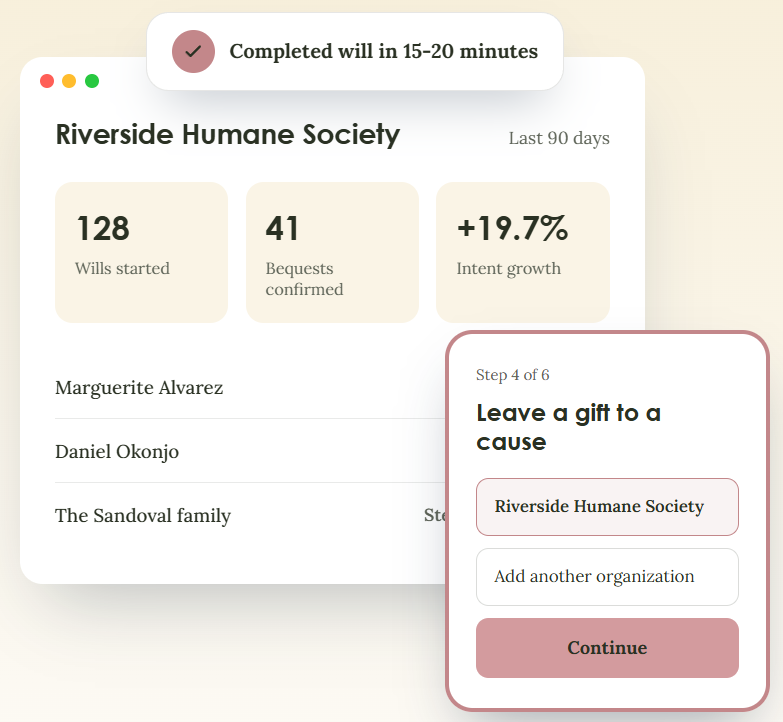
The Guided Will-Builder turns that awareness into a completed gift. It allows donors to create a will in 15 minutes, at no cost to them, removing the friction that keeps most people from ever finishing a will at all.
The Partner Dashboard closes the visibility gap, showing your team every will started and every donor who has included your cause in real time.
Fractional Planned Giving, backed by the LotusGiving Open Ecosystem network of consultants and estate professionals, closes the expertise gap for organizations whose own staff do not yet have the bandwidth or confidence to run this program alone.
What to Do in the Next 90 Days
A realistic starting sequence, regardless of organization size:
- Add one plain-language mention of legacy giving to a communication you are already sending. This could be a newsletter, a giving-page footer, or an annual appeal postscript.
- Provide donors with a specific resource to learn more, rather than a vague mention with no concrete next step.
- Ensure someone on your team is watching for and following up on interest, rather than letting it go unanswered.
- Track who said yes, so the relationship can be stewarded effectively, rather than going quiet until an estate settles.
Frequently Asked Questions
Is this growth sustainable, or a one-year spike?
This has been the third time in four years that bequest giving has grown by 20% or more in current dollars, representing a massive, real-world migration of capital.
Do we need to be a large institution to benefit?
No. As the GOSUMEC example above shows, organizations with zero paid staff can generate 85% of their gifts through asset transfers when given the right tools.
Does a planned giving program cannibalize annual cash giving?
No. After a donor formally adds a charity to their estate plan, their annual current giving to that same organization increases by an average of 75% to 77%.
Where did you get this information?
Sources
- Giving USA 2026: What the Latest Data Means for Capital Campaigns
- 50+ Planned Giving Statistics, Trends & Benchmarks to Know
- Giving USA 2026: The Annual Report on Philanthropy for the Year 2025. Researched and written by Indiana University Lilly Family School of Philanthropy. Published by Giving USA Foundation, a public service initiative of The Giving Institute. Available online at www.givingusa.org.
- Baylor Receives $200 Million Gift for Aging Research
Ready to turn today's donors into tomorrow's legacy?
Make it easier, simpler, and accessible for your supporters to add your mission to their final plans.
Start for Free Book a demoGet the latest legacy giving data
Quarterly bequest benchmarks and wealth-transfer trends for your team.
Recommended guides & articles
 Giving Trends & Data
What The Great Wealth Transfer Means for Fundraising Orgs
6 min read Giving Trends & Data
How Charitable Deductions Changed in 2026 (+ What it Means)
7 min read For Nonprofits
How Non-Binding Bequest Intention Forms Record Legacy Pledges
9 min read For Nonprofits
9 Must-Have Elements for a Standout Planned Giving Web Page
8 min read